The Lifeline program gives SNAP recipients a free government phone and monthly service plan at zero cost. But only about 20% of eligible households have ever signed up.
That gap between eligibility and enrollment is the real story here. Millions of people on food stamps qualify automatically and never apply because they assume the process is complicated or the benefit is gone.
This article is for the SNAP cardholder who has been meaning to look into a free phone but keeps putting it off. If that sounds familiar, keep reading. The whole thing takes about 15 minutes.
Why SNAP Enrollment Makes You Automatically Eligible
The Lifeline Assistance Program is the federal program behind free government phones in 2026. It is run by the FCC and funded through the Universal Service Fund.
The monthly subsidy is $9.25 per household, and participating carriers use that subsidy to cover a phone and plan entirely.
There are two paths to qualify. One is income-based: a household earning at or below 135% of the Federal Poverty Guidelines (roughly $20,783 per year for one person in 2026). The other is program-based, which is where SNAP comes in.
Categorical Eligibility Through SNAP
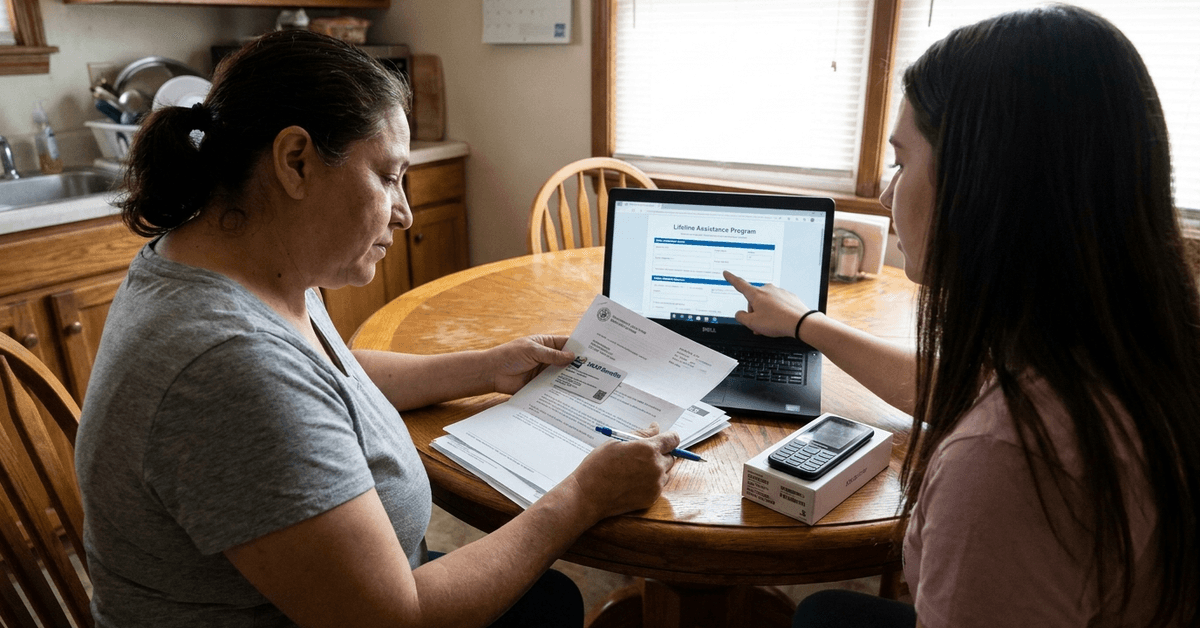
SNAP participation counts as categorical eligibility for Lifeline. That means if someone in the household already receives food stamps, the income verification step gets skipped entirely. No tax returns. No pay stubs. No arguing about what counts as gross household income.
This distinction matters because the income-based path trips people up. Someone working irregular hours or juggling gig income may not know their exact annual total.
SNAP enrollment removes that ambiguity. The benefit letter or EBT documentation is the only proof needed.
Other Programs That Qualify
SNAP is the most common path, but it is not the only one. Medicaid, Supplemental Security Income (SSI), Federal Public Housing Assistance, Veterans Pension, and Survivors Benefit programs all create categorical eligibility.
Tribal programs like Bureau of Indian Affairs General Assistance and Tribal TANF also count.
One household gets one Lifeline benefit. Even if multiple members receive SNAP or hold separate EBT cards, the benefit applies once per address.
The ACP Ended: Lifeline Didn't
A lot of confusion around free government phones in 2026 traces back to the Affordable Connectivity Program (ACP), which ended on June 1, 2024. The ACP gave up to $30 per month toward internet service and served over 23 million households at its peak. Congress never renewed the funding.
Lifeline is a separate, older program that predates the ACP by decades. It has been running since 1985. The ACP's closure did not affect Lifeline at all. Lifeline is fully funded and still accepting new applications as of July 2026.
I think the widespread advice to "wait for an ACP replacement" is the wrong move for anyone currently on SNAP. Congress has introduced legislation to revive the ACP multiple times since 2024, and none of it has passed. Meanwhile, Lifeline's $9.25 monthly subsidy sits unclaimed by roughly 80% of the people who could use it.
Sitting on the sidelines waiting for a $30 program that may never return means passing up a $0 phone plan that exists right now.
How the Application Works Through the National Verifier
Every Lifeline applicant in the U.S. (except those in Texas and Oregon, which have state-run systems) goes through the National Verifier, a centralized eligibility system run by the Universal Service Administrative Company (USAC).
The National Verifier connects directly to federal and state databases. For SNAP recipients, this connection can be a major advantage that almost no guide mentions.
Automatic Database Matching
USAC has Computer Matching Agreements with agencies like SNAP offices, Medicaid, HUD, CMS, and the VA. When a SNAP participant enters their information into the National Verifier, the system checks the federal SNAP database automatically.
If the match hits, approval can be instant. No document uploads. No waiting.
This is the part that makes the "gather all your paperwork first" advice feel outdated. Many SNAP recipients get approved in minutes without submitting a single scan or photo of their benefits letter. The system already knows.
When Documents Are Needed
If the automated check cannot confirm enrollment (due to name mismatches, recent changes in benefits, or state database delays), the National Verifier will ask for documentation.
At that point, a recent SNAP benefits letter or award notice, a government-issued ID, and proof of address get the job done.
Documents submitted online during business hours (9 a.m. to 9 p.m. ET) are typically reviewed within minutes by Lifeline Support Center agents. Paper submissions by mail take seven to ten business days.
Picking a Provider and What the Plans Look Like
After the National Verifier confirms eligibility, the next step is choosing a Lifeline carrier. This is where the experience differs based on location, because not every provider operates in every state.
The major Lifeline providers in 2026 include:
- Assurance Wireless (a T-Mobile subsidiary with broad national coverage)
- SafeLink Wireless (operated by TracFone, available in most states)
- Q Link Wireless (known for relatively generous data allotments)
- TruConnect and AirTalk Wireless (both popular in the western U.S.)
- Gen Mobile (offers Lifeline enrollment with Android smartphones)
Each provider structures its plan differently, but the general floor in 2026 looks like unlimited talk and text plus 4.5 GB of data per month. Some carriers in certain states offer more data or even unlimited plans.
What Phone Do I Get?
Phones are typically entry-level Android smartphones. Think basic models that handle calls, texts, web browsing, and apps. Nobody is shipping iPhones through this program.
Flip phones are still available for anyone who prefers them, but smartphones are now the default at most providers.
Devices arrive new or refurbished, usually with a basic warranty. Some providers ship the phone by mail after approval. Others have pickup locations or retail partners. The phone typically comes pre-activated with the SIM already installed.
| Feature | Assurance Wireless | SafeLink Wireless | Q Link Wireless |
|---|---|---|---|
| Monthly Data | 4.5 GB+ | 4.5 GB+ | Up to 15 GB (varies by state) |
| Talk & Text | Unlimited | Unlimited | Unlimited |
| Phone Type | Android smartphone | Android smartphone | Android smartphone |
| Coverage Network | T-Mobile | Verizon/T-Mobile | T-Mobile |
Q Link tends to offer the most data, but coverage depends on where the reader lives. Check the provider's coverage map before signing up at lifelinesupport.org.
Can the Plan Be Upgraded?
Some carriers offer paid add-ons for extra data, hotspot access, or international calling. These are optional and come with a small monthly fee. The base Lifeline plan itself is free.
Keeping the Phone Active After Approval
Lifeline is not a one-time benefit. It requires annual recertification to confirm the subscriber still qualifies. USAC sends reminders by mail, text, and email before the deadline.
Missing the recertification window means losing service. The fix is usually just re-submitting the same information, but the gap in service can be stressful for anyone relying on the phone for work contacts, medical appointments, or school communication.
A few things to keep in mind for staying enrolled:
- Use the phone at least once every 30 days (a call, a text, or data usage counts)
- Respond to recertification notices promptly, ideally through the online portal
- Report address changes to the provider, since the benefit is tied to one household address
- Never sell, trade, or give away the Lifeline phone, as this violates program rules and can result in removal
Scams and Common Mistakes to Avoid
The official Lifeline sign-up process never charges an upfront fee. Any company asking for money to apply or to "reserve" a spot is not part of the real program.
The FCC's Lifeline page has a fraud tip line at 1-855-4LL-TIPS for reporting suspicious offers.
Other mistakes to watch for:
- Applying through multiple providers at the same address. The National Verifier will reject duplicate applications, and attempting it can flag the household for review.
- Letting someone else use the phone regularly. The benefit is for the enrolled subscriber. Sharing the device long-term can create problems during recertification.
- Ignoring coverage before choosing a provider. A carrier with great data allotments is useless if the network signal at the subscriber's address is weak. Check coverage maps first.
Questions People Ask About Free Government Phones for Food Stamps Recipients
These are the questions that come up most often when SNAP cardholders look into Lifeline.
- Q: Can I get a free government phone if I already have a phone plan?
Lifeline is one benefit per household. If another person at the same address already receives Lifeline, a second enrollment will be denied. But if nobody else at the address has Lifeline, having an existing plan does not disqualify anyone. Some applicants cancel their paid plan after receiving the Lifeline phone. Others keep both. - Q: Does applying for a Lifeline phone affect my SNAP benefits?
No. Lifeline enrollment does not count as income and does not reduce SNAP allotments. The two programs operate independently through different agencies. - Q: How long does it take to get the phone after applying?
If the National Verifier confirms eligibility automatically (common for SNAP recipients), the carrier can ship the phone within a few business days. Total time from application to a working phone is often under two weeks. Mail delivery speed varies by provider and location. - Q: Do I get to choose which phone model I receive?
Selection depends on the carrier and available inventory. Some providers let subscribers pick between two or three Android models. Others ship whatever is in stock. Premium or flagship phones are not part of the program. - Q: Are there state programs that add to Lifeline?
A handful of states, including California and Texas, run supplemental programs that stack additional discounts on top of the federal $9.25 Lifeline benefit. Check with your state's public utility commission or social services office for current availability.
Conclusion
Lifeline remains the only active federal phone assistance program in 2026, and SNAP enrollment is the fastest path to qualifying.
The application takes about 15 minutes online, and SNAP recipients often get approved without uploading a single document.
Roughly 80% of eligible households still have not applied, which means the biggest obstacle is not the paperwork. Skipping the application entirely costs more than any carrier's coverage gaps ever will.